board voting rules
Majority of Votes Cast, Two-Thirds or Majority of the Whole Board: Choosing the Rule for Each Vote
By Perry Price · November 3, 2026 · 5 min read
Every motion raises a quiet question before anyone votes: how many yes votes does it take to pass? The answer depends on the rule, and the same tally can pass under one rule and fail under another. Boards that settle this before the vote avoid an awkward argument after it.
This post explains three common rules in plain words, walks through a made-up example, and then shows how voting works in Qwibie. It is general information, not legal advice.
The three rules in plain words
Majority of votes cast. Count the votes that were actually cast. If more directors vote yes than vote no, the motion passes. Directors who are absent are not counted.
Two-thirds. The yes votes must make up at least two-thirds of the votes cast. This is a higher bar, often asked for on weighty decisions.
Majority of the whole board. The yes votes must be more than half of every seat on the board, whether or not those directors attended. Absence works like a no vote under this rule, because only yes votes can reach the number.
Your bylaws decide which rule applies to your board, and they may define these terms in their own way. Quorum is a separate question: it is how many directors must be present before the board can act at all.
A made-up example
This example is invented for illustration. It is not a real board or a real vote.
A board has 9 directors, A through I. Directors H and I are absent, so 7 directors are present, and we will assume that is enough for a quorum. A motion is moved. Directors A through G all vote: 4 vote yes and 3 vote no. Nobody abstains and nobody steps aside, so there are no present directors who are not voting. The two absent directors are simply not part of the vote. Seven votes are cast in all.
- Majority of votes cast: 4 yes against 3 no. Yes has more votes, so the motion passes.
- Two-thirds of votes cast: of 7 votes, two-thirds is a little under 5, so at least 5 yes votes are needed. There are only 4, so the motion fails.
- Majority of the whole board: the board has 9 seats, and more than half of 9 is 5. There are only 4 yes votes, so the motion fails here too.
The tally is the same in all three cases. Only the rule changed. That is why the rule needs to be settled and written down before the vote opens, not discovered when the result is read out.
How voting works in Qwibie
In a meeting, each vote's rule is chosen: a majority of votes cast, two-thirds, or a majority of the whole board. Your bylaws decide which rule applies to your board. Qwibie also gives you the mechanics to run the vote cleanly. You can read the full description at how voting works in Qwibie.
- A person runs the vote. A person opens and closes every vote and declares quorum. Steward never votes.
- The motion is frozen when voting opens. A motion's text can't change once voting opens. If it needs to change, the vote is closed and a new one starts, so everyone votes on the same words.
- A director can step aside. When a director steps aside from a vote, their vote is left out of the count.
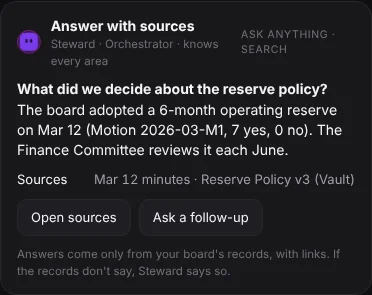
Steward can help you find the rule. Once your organization type and state are set, it shows the voting rules Qwibie has on file for them, with citations. As the example above shows, small differences in the rule can change the outcome, so treat those rules as a starting point. Your bylaws may be stricter, and Qwibie is not a law firm and does not provide legal advice. If your bylaws and a rule on file disagree, ask your attorney how your bylaws and state law apply to you. Steward answers from your own minutes and documents, with sources, so you can also ask it what your board decided last time and follow the sources back to the page.
Votes between meetings
Not every decision waits for a meeting. Outside a meeting, Qwibie uses unanimous written consent. If anyone votes no, abstains or asks for a meeting, the decision goes to a meeting. Votes decided by a majority happen in a meeting.
That is why the three rules above matter most in the room. In a meeting, a person opens the vote and the rule you chose decides the result.
Habits that help
- Name the rule when the motion is made, and have the secretary record it with the result.
- Check your bylaws for actions that call for more than a simple majority.
- Know who is present, who is absent and who stepped aside before you read the tally.
- Do not change the wording of a motion in the middle of a vote. Close it and start again.
Try it on a real motion
The easiest way to see this is to set up a meeting with a real motion, pick the rule, and watch how a vote opens, closes and gets recorded. Qwibie is built first for nonprofit boards, and boards of for-profit and private companies are welcome too. The 14-day trial needs no card, and everyone on your board is included. You can start it on the pricing page.